 |
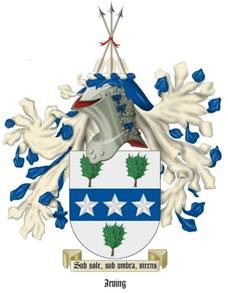
Family HistoryFor visitors who wish to view our genealogy data click here or on the family crest at the left. This data is presented using The Next Generation (TNG)© genealogy web tool. If needed, there is a brief HowTo page accessible from the genealogy data home page to help you start using the tool. For those visitors who do not want to browse through boring genealogy data, we have compiled reports, tables and diagrams. These artifacts are generated from our master Ancestral Quest (AQ)™ genealogy database tool. Scroll down or click here to access this information. Briefly, our Irving ancestors appear in New Brunswick, Canada mid-1800’s. Foster ancestors arrived in the early-1600’s and married with other families who were original settlers of New England. Irving and Foster both immigrated from the United Kingdom. Refer to the Allied Families diagram (link later on this page) to see some of our ancestors in North America. |
|
Surnames in the old country |
We know virtually nothing about our Irving & Foster ancestors prior to them coming to North America. However, DNA Y-Chromosome tests indicate a high probability that we are descended from a common Irving ancestor from the Scottish Borders, probably Dumfreisshire (now Dumfries), who lived in the thirteenth or fourteenth centuries. The DNA test results are recorded and explained on the clanirwin.org DNA Study website. Our entry is identified as record: TC3BZ in the results table available for download from there. The Irving and Foster surnames are both intertwined with the history of the peoples of the British Isles. Some teasers are provided below. Detail information about these surnames can be found on websites accessible on our links page. Considerable research on the Irving/Irvine and Foster/Forester/Forrester surnames (various spellings) has been performed by other researchers. Their research is available on Internet sites listed on our Links page; interesting reading and a good start for expanding your knowledge of the history of the United Kingdom. There are two documents, one for Irving and another for Foster in the Histories section of our genealogy data. Those documents contain what we know about persons with those names in the Unitied Kingdom prior to our ancestors moving to the North American continent; view History documents in the genealogy section. |
|
IRVING Origins 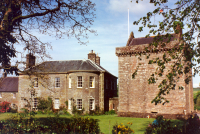 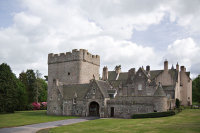 |
Either before or during the time of the Roman occupation of Briton a group of Gaels whose descendants would use the surname Irving settled on the west coast of Scotland at a place they named after themselves; now named Irvine. In the early 11th century a member of this clan marries the daughter of the Scottish king and fathers a future king of Scotland beginning multiple Irving generations of Scottish kings (the House of Dunkeld). The first was Duncan who was killed by Macbeth in battle; not murdered as is told in Shakespeare’s play Macbeth. Macbeth was killed by Duncan’s son and the next nine kings of Scotland are of the Irving clan. Also in the early 11th century many of this clan moved to southwest Scotland and settled there on the border with England. Their land will be known as the parish of Irving with the family seat at Bonshaw Tower. Bonshaw Tower, shown at left, remains in the family. About two hundred years later (in 1323) a member of the Irving of Bonshaw clan was awarded lands near Aberdeen in northeast Scotland, thus establishing the family branch known as the Irvines of Drum. Drum castle, shown at left, remained in the family until 1975. In the early 17th century members from the Bonshaw and Drum branches of the family settled in Northern Ireland when the British established the Ulster Plantation. They built Castle Irvine in Irvinestown, county Fermaugh. |
|
FOSTER Origins 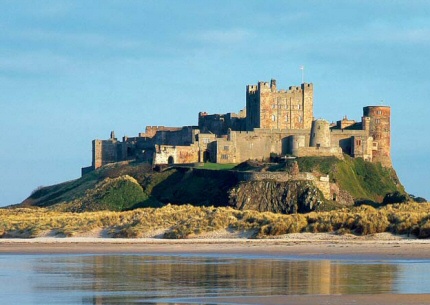 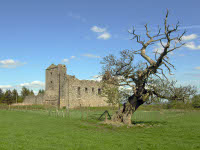 |
Descendants were governors of Bamburgh Castle on the North Sea coast in Northumberland, show at left from 1191 until about 1700 and for a time actually owned the castle. A branch of the Northumberland family was established in the London area in the early 16th century who had close ties with the Royal Tutor family and included high court justices owning impressive estates (such as The Great Fosters and Aldermaston) in southern England. See those estates via our Links Page. The Forsters in Northumberland as well as the Irvings of Bonshaw (Scotland) were well known Border Reiver families that raided and fought invaders along the Anglo-Scottish border. Another branch resided in the Scottish low lands in the vicinity of Edinburgh and Stirling. One of their ancestral homes was Torwood Castle just south of Stirling, now in ruins shown at left. |
|
Current Status - 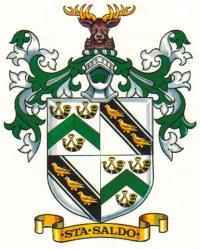 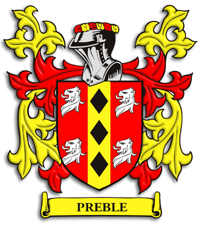 |
What we know
The Allied Families diagram shows our direct ancestors as well as a few interesting side relations. This diagram was developed as a research aid (memory jogger). The individuals at the right-side are, mostly, our brick walls that need further research. - Where did these people come from and/or who were their ancestors? The following links will open PDF formatted files. You need to have the ability to open Adobe PDF files to view these files. To get a Free copy of Adobe Reader go to: Adobe Reader download Allied Families Diagram Diagram of our original immigrant ancestors in North America The following reports include descendants of our original immigrants, shown on the diagram. William Irving Descendant Report Descendants of our first Irving ancestor in North America Obadiah Seely Descendant Report Passenger on ship Arbella (Whithrop Fleet); in Salem, MA 1630; a descendant married our original Irving immigrant in North America John Foster Descendant Report Our original Foster immigrant was in Salem, MA before 1657; a direct ancestor to Laura Foster Abraham Preble Descendant Report Our original Preble immigrant was in Scituate, MA 1636; a direct ancestor of our maternal grandmother Elder William Brewster Descendant Report Pilgram leader and passenger on the Mayflower, 1620 Plymouth, MA; our ninth great-grandfather Reginald Foster Descendant Report Another Foster immigrant sailed with the Whithrop Fleet; in Salem, MA 1638; (no known relation to John Foster, above) a descendant married into the Irving family John Knight Descendant Report Arrived on ship James in Mass Bay 1635; a descendant married into the Preble family Samuel Walker Descendant Report in Mass 1650; another ninth great-grandfather Joel Jenkins Descendant Report in Braintree, Mass before 1640; an eigth great-grandfather |
|
Reports and other artifacts. |
Reports from our master Ancestral Quest (AQ) database or other third-party tools. Additional reports are available at the Genealogy Pages under Reports. People alive in the early 1600's Individuals in our database that were alive during first half of the 17th century; thus likely emigrated. New England marriages prior to 1700 References to the Torrey marriage research project - marriages recorded in New England prior to 1700 |

Irving Family Pages |